Taking a small break from ruminating about Israel to return to the subject at hand. This coming Shabbat, Parashat Vaera, I'm chanting a short section all about hatzefard'im: frogs, as in Pharoah's plea to make then disappear. (They did, but not before dying in heaps and rotting in the fields, which we don't talk about while eating matzah ball soup at the Passover seder.) Say the word hatzefard'im five times fast and you'll either master a tongue-twister or chant my portion. Whomever coined the word captured the very essence of jumping up, down and sideways at the same time.
When I first started learning these verses, I read the word as hatzefar'dim--emphasis on the "r" sound. Then I consulted my second, fancier tikkun, which helpfully placed an oversized letter dalet (the "d" sound") in the middle of the word, meaning this was the letter to stress. But I couldn't; my vocal apparatus was insufficiently gymnastic, and I kept tripping over my tongue. I guess I could have called my old chanting teacher, or (horrors) the cantor himself for pronunciation advice, but they have much better things to do than ponder errant letters. I checked, instead, with the infinitely patient Internet Cantor, the mellifluous voice at bible.ort.org. He added a slight "ah" vowel under the dalet--a syllabic WD40, barely noticeable, to help one sound maneuver to the next.
(Sometimes it's such a relief to be immersed in these fascinating but relatively useless details instead of drowning in plain old daily life.)
I'm sure I'll know my section well by Shabbat, when I'll discover if reading a few weeks ago at the most awesome spot in the world to do such things managed to cure me of last November's paralyzing nerves.
Tuesday, January 24, 2006

Sunday, January 22, 2006
260. Holy?
In a response to this post, Rachel posed an interesting question: is Israel holier than other places?
This, I think, is the issue with which I struggled (in the guise of many others) before my trip. Israel is the site of ancient events central to three religions. Its land is hallowed, its remaining walls places of God. So of course it's holy, QED.
But is land sacred because memory declares it so? Or is holiness an active state, renewing and proving itself over time? This is the standard to which people are bound; prior acts of goodness will never justify unethical behavior later in life. But the same doesn't seem to hold true for places. One of our rabbis admitted that Tel Aviv seemed holier to him than Jerusalem, where you can cut the tension in the air with a knife. In Tel Aviv there's a sense of freedom--to think, worship, live however you want. Isn't that more sacred than hatred?
I don't know. I was awestruck in Jerusalem by the echoes in the stones, the sunlight reflecting on sand just as it did thousands of years ago. I knew I was in a place of origin, and being there made me feel whole. But whole is not the same as holy. Before my trip, as now, I was more deeply moved when reading about the Wall than at that moment when my fingers traced its crevices. I stood in its shadows and could not forget the anger and tears of others who worshipped yards away at the Dome of the Rock. This has nothing to do with politics; who's right or wrong doesn't matter. What does is that lives continue to be lost over the question. I have trouble understanding how a city defined by this struggle is holier than other places where people live in peace. I know that "Israel" means "God-wrestler," and that the Jewish people are defined by our ability to challenge and persevere--but the fight has to end eventually, or there will be no one left to wrestle.
Time is sacred in Jewish life, much more so than place. I believe that the moments when we prayed, during the trip, for peace in Israel were indeed holy and perhaps, in some small way, brought healing to the city in which we stood.
Friday, January 20, 2006
259. Israel, part 10
And here is how I ended that letter to my family and friends:
Now
I had hoped to end with sweeping conclusions about my week, but I can't. There's still too much to think about--to bring back, discuss, discover. I do know I was wrong to feel unworthy of visiting Israel. It's the being there that makes us worthy, and not the other way around. "Place" means so little these days. We go online and think we've reached the other side of the world, but we're fooling ourselves. We need to breathe its air, meet its people; maybe this is just a human trait, or flaw. I certainly don't pretend to understand much after a week, but this trip was so filled with learning, and the love of our organizers and rabbis of teaching, that I felt and saw more than I ever imagined I would.
I believe we're made of pieces that find us over the course of our lifetimes. The empty part in me about Israel was so big that I was afraid to even try and fill it. Now I can, at least partly, and I hope that greater understanding, and more visits in the future, will make me even more complete.
Thursday, January 19, 2006
258. Israel, part 9
Tues., 1/2
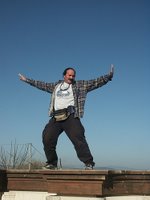 Our last day. Cosi revaya--my cup runneth over--and there was more. In the morning we visited the restored town of Zichron Ya'akov, home of the "first aliyah," where Zionism began in the 1880s with a bunch of incredibly heroic pioneers. In the afternoon we headed to the architectural site of Tzippori and the synagogue where the Mishnah, the Oral Law, was compiled. I was kind of numb with awe. I tried to imagine sages stroking long beards while pacing floors covered with mosaics of Jewish and Roman symbols (they had no trouble living with and borrowing from neighboring cultures). Maybe they took a break occasionally from deep thoughts to look across the hills at towns and valleys rolling in green and sunlight as far as the eye could see, all the way to Nazareth. (The photo at left is of our tour guide demonstrating what might have happened on the stage of Tzippori's two-thousand-year-old outdoor theater.)
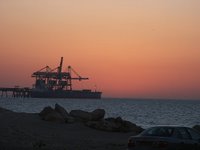 We planned to be at Caesaria at sunset, by the water where Hannah Senesh wrote "Eli, Eli":
"My God, my God
May these things never end:
The sand and the sea
The rustle of the water
The lightning in the sky
Man's prayer."
But just as we got on the bus, a group of men began to ask around for a minyan for minha, the afternoon service. And some of the men in our group obliged, of course, as the women waited off to the side. This happened a few times during our trip, a common sight in Israel. I much prefer the kind of world where I'm counted. The service ended and we tried to race to Caesaria, arriving just as the fat orange sun dropped past the horizon with the suddenness of a bowling ball. We got out and sang for awhile in this beautiful place, and then drove Ne'ot Kedumim, a "Biblical landscape preserve"--gardens and flowers written about in ancient texts--which we couldn't see at all, since it was night. But it didn't matter, because we were there to talk--about what we learned from this trip, and were bringing back--and eat, a final dinner under a big tent, where we danced, sang, cried, and each offered a single word of prayer that, knit together, became one of the best I've ever heard.
A few hours later I got on a plane and emerged in New York the next morning, dazed and tired. (And without my luggage, which returned five days later from destinations unknown. I guess it didn't want to come home, either.)
 Our last day. Cosi revaya--my cup runneth over--and there was more. In the morning we visited the restored town of Zichron Ya'akov, home of the "first aliyah," where Zionism began in the 1880s with a bunch of incredibly heroic pioneers. In the afternoon we headed to the architectural site of Tzippori and the synagogue where the Mishnah, the Oral Law, was compiled. I was kind of numb with awe. I tried to imagine sages stroking long beards while pacing floors covered with mosaics of Jewish and Roman symbols (they had no trouble living with and borrowing from neighboring cultures). Maybe they took a break occasionally from deep thoughts to look across the hills at towns and valleys rolling in green and sunlight as far as the eye could see, all the way to Nazareth. (The photo at left is of our tour guide demonstrating what might have happened on the stage of Tzippori's two-thousand-year-old outdoor theater.)
 We planned to be at Caesaria at sunset, by the water where Hannah Senesh wrote "Eli, Eli":
"My God, my God
May these things never end:
The sand and the sea
The rustle of the water
The lightning in the sky
Man's prayer."
But just as we got on the bus, a group of men began to ask around for a minyan for minha, the afternoon service. And some of the men in our group obliged, of course, as the women waited off to the side. This happened a few times during our trip, a common sight in Israel. I much prefer the kind of world where I'm counted. The service ended and we tried to race to Caesaria, arriving just as the fat orange sun dropped past the horizon with the suddenness of a bowling ball. We got out and sang for awhile in this beautiful place, and then drove Ne'ot Kedumim, a "Biblical landscape preserve"--gardens and flowers written about in ancient texts--which we couldn't see at all, since it was night. But it didn't matter, because we were there to talk--about what we learned from this trip, and were bringing back--and eat, a final dinner under a big tent, where we danced, sang, cried, and each offered a single word of prayer that, knit together, became one of the best I've ever heard.
A few hours later I got on a plane and emerged in New York the next morning, dazed and tired. (And without my luggage, which returned five days later from destinations unknown. I guess it didn't want to come home, either.)
Wednesday, January 18, 2006
257. Israel, part 8
Mon., 1/1
I could scarcely believe the trip was almost over. The week felt like a lifetime.
 Today's theme was service to Israel. We learned that tzedakah (charity), the center of a Jewish life, is paradoxically less so for contemporary Israelis, who grew up in a culture valuing strength, defense, growth--but not necessarily giving. In the morning we joined Table to Table, a food rescue organization, at a farm to pick tomatoes not collected during the harvest and slated to rot on their vines. Benaya, our tour bus guide, sung off-key at the top of his lungs as he worked; I was afraid his voice would kill the produce. Benaya's exploding excitement was infectious as he helped us see the land through passionate, critical, and extremely knowledgeable eyes. (As "bus boss," official attendance-taker, I had a great time helping him yell into the microphone all week long.) He was very funny, better than coffee at keeping us awake, and as rooted to this place as a tree.
That afternoon back at the hotel we met with young IDF soldiers, including a rabbinical student, a woman of 25. Her job in the army was to help soldiers convert to Judaism. We were confused; isn't everyone in the army already Jewish? Yes, according to the state, which requires that one's father be Jewish. But halakha, Jewish religious law, calls for martilineal descent. Many immigrants from Russia, new to Israel and identifying completely with heritage for which they had been persecuted back home, join the army and are suddenly an underclass--not really Jewish. Such is the tangle of identities in Israel.
Afterwards we headed to Rabin Square, the site of his assassination ten years ago, and listened to one of our guides speak with grief and anger about the wrenching loss of hope on that day from which the country has never recovered.
We lit candles back at the hotel lobby for the final evening of Hanukkah. Then friends and I took a cab to Old Jaffa for a magnificent dinner at a little Italian/Moroccan restaurant, followed by a sublime dessert of warm, fudgy chocolate cake at a café overlooking the water and lights of Tel Aviv.
I could scarcely believe the trip was almost over. The week felt like a lifetime.
 Today's theme was service to Israel. We learned that tzedakah (charity), the center of a Jewish life, is paradoxically less so for contemporary Israelis, who grew up in a culture valuing strength, defense, growth--but not necessarily giving. In the morning we joined Table to Table, a food rescue organization, at a farm to pick tomatoes not collected during the harvest and slated to rot on their vines. Benaya, our tour bus guide, sung off-key at the top of his lungs as he worked; I was afraid his voice would kill the produce. Benaya's exploding excitement was infectious as he helped us see the land through passionate, critical, and extremely knowledgeable eyes. (As "bus boss," official attendance-taker, I had a great time helping him yell into the microphone all week long.) He was very funny, better than coffee at keeping us awake, and as rooted to this place as a tree.
That afternoon back at the hotel we met with young IDF soldiers, including a rabbinical student, a woman of 25. Her job in the army was to help soldiers convert to Judaism. We were confused; isn't everyone in the army already Jewish? Yes, according to the state, which requires that one's father be Jewish. But halakha, Jewish religious law, calls for martilineal descent. Many immigrants from Russia, new to Israel and identifying completely with heritage for which they had been persecuted back home, join the army and are suddenly an underclass--not really Jewish. Such is the tangle of identities in Israel.
Afterwards we headed to Rabin Square, the site of his assassination ten years ago, and listened to one of our guides speak with grief and anger about the wrenching loss of hope on that day from which the country has never recovered.
We lit candles back at the hotel lobby for the final evening of Hanukkah. Then friends and I took a cab to Old Jaffa for a magnificent dinner at a little Italian/Moroccan restaurant, followed by a sublime dessert of warm, fudgy chocolate cake at a café overlooking the water and lights of Tel Aviv.
Tuesday, January 17, 2006
256. Israel, part 7
Sat., 12/31
Shabbat was, theoretically, a day of rest, but I spent much of it wandering through Tel Aviv, which felt like New York--free, open, vital, very different from Jerusalem. This was the last day of the year? It was business as usual, since New Year's, CE version, isn't a holiday here. Strange. After a long walk on the beach behind our hotel (which took me by surprise... I had forgotten Tel Aviv was right on the water, and had no idea it would look so much like Miami, one big hotel after another), we had Shabbat services this morning as profound as last night's, and I chanted Torah for the third time. (I was so exhausted and overwhelmed by this point in the week that I couldn't discern one kind of amazing from another. I remember the day now as if submerged under a big wave of happiness, details all blurred together.) Lunch just a few feet from the sea, and then another long walk through this city pieced together from buildings old and new, massive and intimate, with lots of clubs and discos and a little of everything else, as well.
(I also gained new appreciation for being a designer who works in the English language. Hebrew is beautiful when written or typeset in a classic font, but looks really strange in neon. There aren't enough letters; a resh, nun, and samech together [as in "Renaissance Hotel," and other odd transliterations], minus serifs, calligraphic flourishes, and the interruption of vowels of equal stature rather than little dots above and below, look like a stick-figure drawing of half a face. The Romans knew what they were doing.)
Havdalah and candlelighting on the beach that evening, the menorah made of candles stuck in the sand, the besamim (spices) mint leaves, and our singing accompanied by the slow rush of waves. After dinner at a little boardwalk restaurant, the second walking tour of the day--Bauhaus architecture, of which Tel Aviv is a major world center. At midnight, a champagne toast by the water, reminding me for the first time in days that my home was on the other side of the world where such things mattered, and where it was a little colder than 70 degrees.
Monday, January 16, 2006
255. Israel, part 6
Fri., 12/30
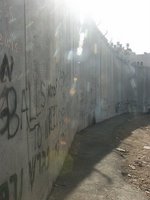 Our final day in Jerusalem began with a tour of East Jerusalem and the "separation barrier" with a representative from Ir Amim ("City of Nations" or "City of Peoples"). Again, I was struck by how small this country is. You can almost hold it in your hand, the conflict visible at a glance from any hill--Jews here, Arabs there. War over a piece of land that could be someone's backyard in Texas, if Texas happened to be the holiest site in the world for three religions. We learned that much of the barrier separates Palestinians from Palestinians, not Jews, and that its perimeter was determined by politics and gerrymandering. We were shocked at the sight of streets filled with garbage; although East Jerusalem falls within municipal boundaries, it's mostly neglected in the budget. We watched a pregnant woman squeeze though an opening in the wall, unseen or ignored by a guard with a gun just a few feet away. I understand why the barrier is needed, and also don't understand. It's very disturbing and complicated.
We drove to Tel Aviv, an entirely different world, landscape, and political climate less than an hour away. More great falafel for lunch and an hour speed-shopping at the Nachalat Binyamin crafts fair, my favorite sort of place, where everyone was pleasantly rude.
Then a most amazing Kabbalat Shabbat with a number of local congregations--many of them secular, people who get together for study and community service, but without the religious part. Which makes complete sense here; it's all or nothing. Even "nothing" in New York tends to include forced tenure at Sunday School, or Yizkor once a year--but in Tel Aviv, where public schools close for Hanukkah, a Bar Mitzvah is just a party. Religion is state sponsored, and has no middle. I never really understood how lucky I was to be an American Jew, with the freedom to explore any number of shades of gray. That Friday evening we watched the Israelis' joy unfold during the service like light reflecting off a precious jewel, and we danced and sang for hours afterwards. What a wonderful gift we were allowed to share. One of our security guards, a large stone-faced guy, said afterwards that he always felt Israeli but never Jewish until that Shabbat, and cried when he saw the Sefer Torah being taken out of the Ark the next morning.
 Our final day in Jerusalem began with a tour of East Jerusalem and the "separation barrier" with a representative from Ir Amim ("City of Nations" or "City of Peoples"). Again, I was struck by how small this country is. You can almost hold it in your hand, the conflict visible at a glance from any hill--Jews here, Arabs there. War over a piece of land that could be someone's backyard in Texas, if Texas happened to be the holiest site in the world for three religions. We learned that much of the barrier separates Palestinians from Palestinians, not Jews, and that its perimeter was determined by politics and gerrymandering. We were shocked at the sight of streets filled with garbage; although East Jerusalem falls within municipal boundaries, it's mostly neglected in the budget. We watched a pregnant woman squeeze though an opening in the wall, unseen or ignored by a guard with a gun just a few feet away. I understand why the barrier is needed, and also don't understand. It's very disturbing and complicated.
We drove to Tel Aviv, an entirely different world, landscape, and political climate less than an hour away. More great falafel for lunch and an hour speed-shopping at the Nachalat Binyamin crafts fair, my favorite sort of place, where everyone was pleasantly rude.
Then a most amazing Kabbalat Shabbat with a number of local congregations--many of them secular, people who get together for study and community service, but without the religious part. Which makes complete sense here; it's all or nothing. Even "nothing" in New York tends to include forced tenure at Sunday School, or Yizkor once a year--but in Tel Aviv, where public schools close for Hanukkah, a Bar Mitzvah is just a party. Religion is state sponsored, and has no middle. I never really understood how lucky I was to be an American Jew, with the freedom to explore any number of shades of gray. That Friday evening we watched the Israelis' joy unfold during the service like light reflecting off a precious jewel, and we danced and sang for hours afterwards. What a wonderful gift we were allowed to share. One of our security guards, a large stone-faced guy, said afterwards that he always felt Israeli but never Jewish until that Shabbat, and cried when he saw the Sefer Torah being taken out of the Ark the next morning.
Sunday, January 15, 2006
254. Israel, part 5
Thurs., 12/29
 Shaharit at the Southern Excavations of the Wall, where I had the privilege, one of the most enormous I will ever have in this lifetime, or any other, of chanting Torah. This remaining part of the Temple stands perpendicular to the Kotel, the Western Wall. From a little table covered with a tallit that served as our bima I looked up and saw the blue sky, and below that the stones of the wall, and below that the faces of my friends. And below that, the words and letters on the scroll. I thought of those images of the earth from space where the camera zooms closer and closer until what looks like a speck of color turns out to be a whole country, then a city, then a house. Every small thing is part of a universe much larger, and vice versa. As I read, the words in the scroll seemed to lead the yad (the pointer) through each sentence like stones on a path, going by so fast I almost couldn't keep up. I had a sense, in that minute or two of reading, that the letters were having fun, dancing, taking me somewhere unknown and joyful.
Here on the steps of the gate through which pilgrims once entered the Temple I read the portion for Hanukkah about offerings brought to the tabernacle, and so was able to give my own.
Afterwards we had some time at the Kotel itself. It's much smaller than I imagined, as is everything in this country. I touched the stones, cried, watched pigeons nestle in two-thousand-year-old crevices, absorbed the fervor of everyone around us--but the Southern Excavations seemed holier to me, where I was able to stand together with all my friends, both men and women, without a barrier between us. I don't know how to pray other than with my entire community.
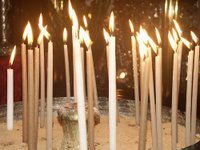 Jerusalem is a city of many different kinds of walls, I guess. After a meandering walk though the Jewish and Arab markets, the Via Dolorosa, and a visit to the Church of the Sepulchre (photo at left), we stopped for 20 minutes of the best falafel I've ever had in my life. Then back on the bus to the Shrine of the Book at the Israel Museum, site of the Dead Sea Scrolls. The lettering on each fragment is tiny and exact, as if each word and mark describes a particular life. I can't really comprehend that kind of oldness. But I think I was even more awestruck by the 10th century Aleppo Codex, the earliest known manuscript containing the full text of the Bible--and trop, cantillation, the notes to which we chant. That book was why I was able to do what I did earlier that morning.
The day ended at Neve Shalom/Wahat al-Salam, a village where, for the last few decades, Israelis and Arabs have somehow managed to live in peace. We listened to their extraordinary story, watched a strange but entertaining 2-man play, and then returned to the hotel, where (even after a huge cup of Turkish coffee) I slept very, very well.
 Shaharit at the Southern Excavations of the Wall, where I had the privilege, one of the most enormous I will ever have in this lifetime, or any other, of chanting Torah. This remaining part of the Temple stands perpendicular to the Kotel, the Western Wall. From a little table covered with a tallit that served as our bima I looked up and saw the blue sky, and below that the stones of the wall, and below that the faces of my friends. And below that, the words and letters on the scroll. I thought of those images of the earth from space where the camera zooms closer and closer until what looks like a speck of color turns out to be a whole country, then a city, then a house. Every small thing is part of a universe much larger, and vice versa. As I read, the words in the scroll seemed to lead the yad (the pointer) through each sentence like stones on a path, going by so fast I almost couldn't keep up. I had a sense, in that minute or two of reading, that the letters were having fun, dancing, taking me somewhere unknown and joyful.
Here on the steps of the gate through which pilgrims once entered the Temple I read the portion for Hanukkah about offerings brought to the tabernacle, and so was able to give my own.
Afterwards we had some time at the Kotel itself. It's much smaller than I imagined, as is everything in this country. I touched the stones, cried, watched pigeons nestle in two-thousand-year-old crevices, absorbed the fervor of everyone around us--but the Southern Excavations seemed holier to me, where I was able to stand together with all my friends, both men and women, without a barrier between us. I don't know how to pray other than with my entire community.
 Jerusalem is a city of many different kinds of walls, I guess. After a meandering walk though the Jewish and Arab markets, the Via Dolorosa, and a visit to the Church of the Sepulchre (photo at left), we stopped for 20 minutes of the best falafel I've ever had in my life. Then back on the bus to the Shrine of the Book at the Israel Museum, site of the Dead Sea Scrolls. The lettering on each fragment is tiny and exact, as if each word and mark describes a particular life. I can't really comprehend that kind of oldness. But I think I was even more awestruck by the 10th century Aleppo Codex, the earliest known manuscript containing the full text of the Bible--and trop, cantillation, the notes to which we chant. That book was why I was able to do what I did earlier that morning.
The day ended at Neve Shalom/Wahat al-Salam, a village where, for the last few decades, Israelis and Arabs have somehow managed to live in peace. We listened to their extraordinary story, watched a strange but entertaining 2-man play, and then returned to the hotel, where (even after a huge cup of Turkish coffee) I slept very, very well.
Saturday, January 14, 2006
253. Israel, part 4

Weds. 12/28
(A photo--the Old City in the distance--from Tuesday evening en route back to the hotel, capturing my out-of-focus, overwhelmed state.)
 Hiked up Masada. The stones are so clean! In Rome twenty years ago, I was saddened by how old and dirty everything looked. I expected the same of these ancient ruins, as well, but everything is drenched in sunlight. It almost looks new. I had no idea that at the top of Masada lie shadows of homes, a synagogue, outlines still clinging to the edges of the tan-red precipice of Roman outposts that the Jews must have glimpsed with terror as, with honor, they took their own lives. At the end of this expanse, a swath of green-blue sea clear as an eye.
None of the photos I'd seen of Jerusalem prepared me for the waves of hills and valleys alongside all the roads travelled by our bus, bowls with dusty white-walled homes climbing in spirals up their their insides, one after another, to make up the landscape.
 After a brief stop for lunch at the side of the Dead Sea, which I touched for about a second, we headed to Ein Gedi, a nature preserve. This is what Eden must have looked like. The gazelles leapt here as David watched and wrote. We climbed up to a waterfall, and I think I finally understood--why people dreamed, fought, died for this land, and continue to do so. Why we pray about it. At that moment it seemed as if I had never been in such a beautiful place in all my life. And I felt, in a way I don't really understand, like I had been here always.
Friday, January 13, 2006
252. Israel, part 3
Arrival, Tues. 12/27
The first half of our week was in Jerusalem. We stayed at Ramat Rachel, a nice, unpretentious hotel on a historic kibbutz. Jet lag and impatience for the day to begin kept me awake most of that first night, a little troubling since the very first thing I had to do on my very first day in Israel was chant Torah at morning minyan. I wore my white High Holy Day tallit, which seemed the only proper attire for this city. I felt like I was still dreaming. In a small, airy room on the lower level of the hotel, sunlight streaming through a window from above, I trembled as I read and tried to imagine what stretched beyond that sliver of sky, and the actual place we turned to face every week at services.
Later that morning, after hearing a lecture by journalist Tom Segev about his adopted Ethiopian son and the challenges facing modern, multi-ethic Israel, we visited a center when Mizrahi Jewish women (of eastern and Sephardic descent) learn to be entrepreneurs and gain a voice in a society where they're an underclass, and very often victims of racism. Some are now chefs--we ate their wonderful food--and heard the music of an Iranian-Jewish woman who escaped an abusive husband and, thanks to this organization, went back to school and is now an acclaimed performer. (She was accompanied by a man on the segur, an instrument I'd never seen before, kind of like a dulcimer but cooler). We spent that afternoon at Yad Vashem, about which my words cannot do justice. I experienced similar emotions at the Holocaust Museum in Washington, D.C. but here in Israel, grown from the ashes of those days, I felt like I had stepped into the deepest pit. After a brief visit to the enormous menorah outside the Knesset, followed by dinner and candlelighting at the hotel, we listened to a performance at the hotel by Yair Dalal, who played the oud like all of Israel was dancing on his fingertips.
It was a long day--I was dazed, exhausted, and very happy--but still not sure if I belonged here.
------
On another topic: I helped lead services again this evening (the eleventh time). I was surprised to be asked; we now have three rabbinic interns, plus another layperson who's been doing this for years, so I'm way down in the list of people who get to do this amazing thing. I had enormous fun, and it felt different, somehow, than all the other times. Maybe I'm different now. I was in a kind of musical fog, like walking on a road with a rhythm so comfortable and familiar that I didn't have to think, but only breathe in and exhale the song. We sat in a semicircle, the rabbi, musicians and I, surrounded by the rest of the congregation. I could see their faces--the drummer next to me as clearly as the man in the last row--as we built this one big prayer together.
Wednesday, January 11, 2006
251. Israel, part 2
Here's the beginning of a letter I'll (soon) send out to family and friends, some ideas which I've posted here before.
-------
There is generally nothing more boring, especially for those who weren't on the trip, as a letter about one's vacation. But I know my powers of speech will fail if anyone asks how it was, and I'll be able to offer little else but a tongue-tied "amazing." So, instead, here are some brief (I promise) impressions of the Hanukkah week I just spent in Israel with [my congregation], my first visit ever.
I expected this trip to be about the place and people, and my community--and it was all those things--but mostly it was about me. All my ideas about Israel have been challenged, and most of them changed.
As some of you know, I got on the plane with mixed feelings. Israel wasn't part of the conversation when I was growing up, even though I attended an Orthodox Hebrew school (a really bad one) and my father prayed three times a day. We were concerned with the here and now, and Israel seemed to represent a place, like the Eastern Europe of my grandparents, from which we needed to move on. We sponsored trees and gave tzedaka, but out of a sense of duty rather than passion.
After many years during which I rarely set foot in a synagogue, I joined [...] and discovered I really did like being Jewish. But I still didn't understand the Israel part, and the more involved I became in Jewish life, the more this gap felt like a chasm between myself and the rest of my community. Israel was a color on a map, an angry paragraph in the newspaper. I had no sense of its people or soul. I felt like I was missing a point that everyone around me seemed to get it in a very profound way, and began to wonder if I was even capable of understanding. What right did I have to stand at the bima and chant Torah if I was unable to comprehend the central message of the whole story?
Until the we reached the end of the runway, I wasn't fully convinced I'd get there, or even sure I was supposed to be there at all. I started to change my mind after we landed and I saw Hebrew signs and mezzuzot in the airport. You'll be amazed, my friends had said; everyone in this country speaks in the language of prayerbooks! But I wasn't surprised at all. It seemed completely natural, familiar. I know very little Modern Hebrew, but recognized "Exit/Yetziah" --as in "yetziat Mitzrayim," the exodus from Egypt--in red above all the doorways. This was the language--a whole country full of it--of Shabbat, of secrets and thoughts I admit only to myself and to God.
Tuesday, January 10, 2006
250. Israel, part 1
Finally! My brain was working so fast this past week that I couldn't seem to capture its contents in words. I'm also recovering from a long, drawn-out case of jet lag (this morning was the first time I slept past 3AM since I returned), as well as lingering annoyance about my luggage (which finally arrived on Saturday morning, from destinations unknown). I'm trying to compose a long email to my family and friends about the trip, and will post excerpts--with additions I feel more comfortable writing here, which is kind of strange, but true. Before I begin, however, here's what I wrote on the plane going over:
------
Dec. 26: The security agent at the airport said "Shalom" and I had that shocked moment everyone said would come: yes, they speak Hebrew in Israel! "Ivrit, Anglit?" she continued. "Anglit," I answered. "You didn't learn Hebrew in Hebrew school?" she demanded. "What's your Hebrew name?" "Ahuva." "It's not Ruth?" she yelled, looking at the middle name on my passport, and for a second I was ashamed that my parents gave me the wrong name. Then I realized she must be trying to weed out impostors, or maybe this was the cultural rudeness I had already identified in New York cab drivers. We spent four hours in limbo at the gate--the flight was delayed because of the rain--and finally boarded at 2:30AM in a herd-like free-for-all, after waiting patiently for our rows to be called and then realizing they wouldn't.
As we took off, the lights in the dark sky above Long Island looked like rows of menorahs all lit for the eighth day. (A beautiful image, but still not enough to make up for my ill-considered choice of a window seat, where I remained folded up like a envelope for ten hours.)
I tried to sleep, but my Torah portion kept going through my head.
On the little screen in the seat in front of me I watched a few minutes of a film about the Kotel. It showed a figurative chain of Jews who touched those stones over thousands of years (all men, of course). I started to cry. Soon I could be one of those faces in the circles, at least in the non-Orthodox version of the film. I'm still not sure how much of this emotion is me, and how much is what I think I should be feeling because so many people are excited for me. It's almost 9AM, NY time (3PM here, somewhere over Europe)--maybe I'll know in a few hours.
Tuesday, January 03, 2006
249. Back!
I'm back! But briefly--I need to sleep for a day or two. I am without words--the trip was incredible in all respects. (Well, to be honest, except one--my luggage is missing. The only thing that did not exceed my expectations was El Al. I'm not a fan. They assured me that 98% of lost luggage turns up, and that it will probably be on the next flight to arrive this afternoon. "What happens to the other 2%?" I asked. "Does it fall into the Atlantic?" They didn't laugh.)
[Update: My luggage has been located. It's somewhere between Tel Aviv, where it was held "for security reasons," and NYC. I guess my state of extreme exhaustion made me look dangerous.]
Once I find some new superlatives, and wake up, I'll be able to write some more. One thing I know for certain: before the trip, I had a feeling I wasn't supposed to visit Israel. I was wrong, completely. I was just waiting all my life for the right time.
Wednesday, December 28, 2005
248. As promised, an incoherent post
Here it is. Writing quickly, since I'm paying for time by the minute. Over the past two days, which have felt like a week or maybe a lifetime, I have (among many other things):
--climbed Masada
--hiked in Ein Gedi, and watched the gazelles leap just like King David said they did
--cried at Yad Vashem
--cried everywhere else
--listened to the music of a master oud player
--listened to Mizrahi Jewish women (of easten descent) talk about being an underclass in Israeli society
--ate the amazing food they sell as part of an organization to empower Mizrahi women to become entrepreneurs, despite lives often marked by poverty and violence
--dipped my hands into the Dead Sea
--counted to 40 many times (I am a bus captain or, as the tour guide keeps calling me, "bus boss")
--lit Hannukah candles with 200 people each night
--and, as my very first act in this country, after lying awake all night thanks to excitement and jet lag, chanted Torah.
Tomorrow morning we we'll have services near the Wall, at the southern part where there are excavations (and where men and women are allowed to pray together). And I'll chant Torah again, in the shadow of all history.
In the evening we head to Neve Shalom, an Arab-Israeli village where people are actually managing to live in peace. We'll be in to Tel Aviv for Shabbat.
I never understood before. I don't know how else to say it. This afternoon at Ein Gedi, watching a waterfall, the beauty of this place almost knocked the breath out of me. I feel like I've been here always.
Sunday, December 25, 2005
247. Until later
This past Shabbat morning a line of prayer caught my eye. I thought about it for a moment, and realized it said exactly what I felt about my coming trip. I had read the line many times before, but only now did it make sense in context of my life.
I got home, took out my siddur, and looked for the line... and couldn't find it, not even the part of the service where it fell. Oy, I thought, I need to get more sleep. Here I had a revelation, and now I have no idea what it was about. I did recall that it made me feel excited about the trip, and then calm. I walked out of the synagogue in peace. So I guess the line did its job; maybe I was only supposed to read it once.
I suspect I'll feel this way in Israel, too. Some of what I see and hear will set like concrete in my brain, and other things will stay as the shadow of a color or echo of a laugh, or some emotion I won't be able to name. I look forward to forgetting as much as I remember, and filling in the rest on future trips. There's an internet café in our hotel (and, I gather, on every block in Jerusalem), and I may post something here during the three seconds of free time listed on the itinerary. It might be coherent, or an unreadable stream-of-consciousness narrative that could forever embarrass me in the blogosphere. Most likely I'll be back after Jan. 4. Until then, in the words of a very funny colleague, have a Happy CE New Year! And may 2006 bring only good things for us all.
Subscribe to:
Posts (Atom)